
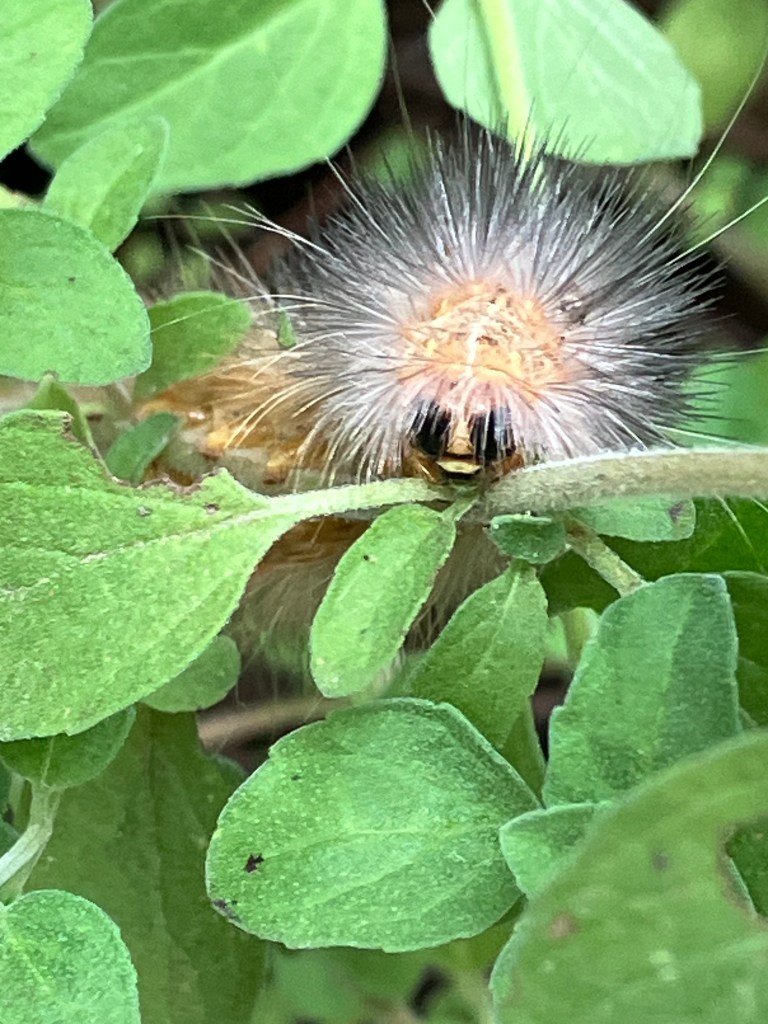
National Moth Week occurs annually during the last full week of July: https://nationalmothweek.org/ Moths “play vital roles in most of the world’s terrestrial ecosystems” because they pollinate night-blooming plants, add nutrients to soil and feed many wildlife species including: birds, bats, rodents, lizards, skunks, bears, insects and spiders. https://www.nwf.org/Magazines/National-Wildlife/2018/April-May/Animals/Moths (explaining that breeding birds rely primarily upon caterpillar moths to feed their young and noting that a single clutch of tiny Carolina Chickadees requires 6,000 to 9,000 caterpillars). Your gardening practices matter to these underappreciated creatures. https://www.xerces.org/blog/gardening-for-moths (also noting that “fewer than 1 percent of moth species eat fabrics such as wool”). The caterpillar in this month’s photo shared some oregano for a few days before advancing to the next stage of his life journey.
Our North Loop urban forest shelters other night flying neighbors. We have Great Horned Owls, Barred Owls and most commonly Eastern Screech Owls that assist us with rodent and cockroach control. Even small yards can benefit bats, and the folks at Austin Bat Refuge have a creative solution to make a bat-friendly swoop down water feature (despite limited open space) by elevating a drinking trough on top of Texas-style tomato cages: https://austinbatrefuge.org/gardening-for-bats/ If you have a palm tree, please leave it untrimmed—especially from May through August when mother bats are nursing non-flying pups in the skirts. “Palm trees are vital habitat for Austin’s yellow bat population and can host up to four other local bat species. To our knowledge, yellow bats roost nowhere else but the brown skirt of palm trees, which hangs below the green crown of live fronds. We’re talking about palms where the bottom of the skirt is at least 12 feet above the ground, allowing bats to drop into flight above the reach of leaping predators,” explains Austin Bat Refuge. “Winter Storm Uri (The Feb 2021 Freeze Event) had a devastating effect on Austin’s palm trees, with over 90% being killed. This makes the skirts on the surviving palms critical to the survival of the two species of yellow bats.” https://austinbatrefuge.org/palm-trees/
You might be surprised by some larger terrestrial night visitors, increasingly exiled due to habitat loss, adapting to our urban life in Austin. It is absolutely possible to coexist with these creatures, and they deserve inclusion in our density accommodations. Considering how much humanity has taken from them, we can do our best to share and avoid unnecessary conflicts. Bobcats are another predator helping manage local rodent populations. https://www.kut.org/austin/2024-07-23/bobcat-mountain-lion-cougar-wild-cats-austin-tx Reassuring us that we should not be alarmed by seeing a fox in our neighborhood, the Humane Society of the United States has helpful information to address frequent concerns: https://www.humanesociety.org/resources/what-do-about-foxes The University of Wisconsin Urban Canid Project recommends that we coexist with canids by following these tips: 1) Don’t Feed Them (deliberately or negligently through unsecured trash or spent bird seed), 2) Monitor Pets, 3) Haze Them (only if they are acting abnormally—but not if they are sick, injured, with pups or near a den with pups–by using the humane techniques as described on their website to preserve their natural fear of humans), and 4) Respect Them.
https://naturalresources.extension.wisc.edu/uw-urban-canid-project/coexisting-with-canids/
 North Loop Neighborhood Association