
The City of Austin’s website states that: “More than 170,000 tons of storm debris were collected from Winter Storm Mara. That’s enough to fill Q2 stadium four times!” https://www.austintexas.gov/stormdebris. We don’t need to have all of our tree limbs, branches and leaves hauled away when our stripped and compacted urban soil is desperate for nourishment. If we have a freeze this winter (or even if we don’t), embracing yard decay promotes life.
There are many options that leave our urban homestead soil better equipped to capture carbon and endure drought. Regenerative gardening “is a style of garden management and planting that is conscious of emissions and waste,” in which tilling is avoided and soil is enriched by adding back organic matter. https://www.gbbg.org/regenerative-gardening-for-soil-health. Spent mushroom blocks from local farms can be used to help process our yard refuse: https://www.centraltexasmycology.org/block-giveaway.
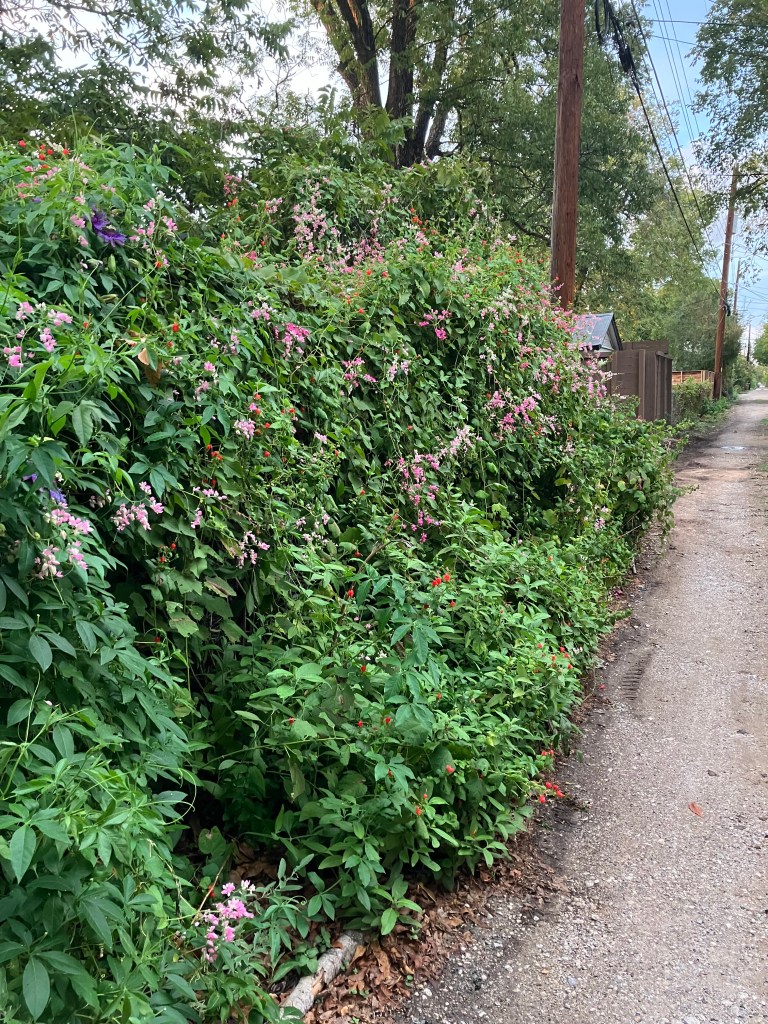
Hügelkultur uses decaying logs and plants to create mounds for cultivation: https://www.almanac.com/what-hugelkultur-ultimate-raised-bed. Even if one doesn’t want traditional mounds, yard debris can be used to construct and/or fill raised garden beds (thereby reducing the need to purchase garden soil). https://www.permaculturenews.org/2012/06/24/raised-beds-and-soil-rehab-with-yard-waste/. A compost wall or fence, such as the one in this month’s photo supporting an alley pollinator garden, also provides habitat for birds. https://www.motherearthnews.com/diy/garden-and-yard/compost-fence-zm0z23jjzawar/.
 North Loop Neighborhood Association