
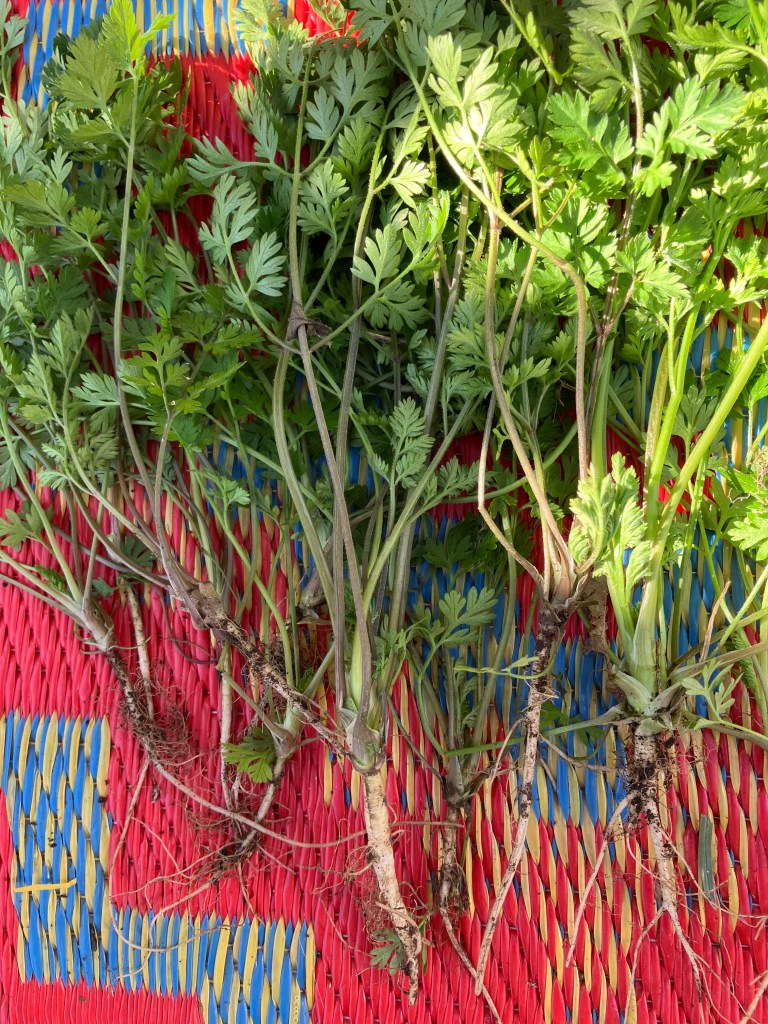
If you are trying to diversify your urban wildlife habitat, the reality of “xeriscaping” is that you may need to tackle some of the (often non-native) plants that crowd out the competition. Weeding by hand is laborious, but it is the safest way to leave desirable plants without harming soil or other creatures.
The purple flowers of Henbit are already visible. To be fair, this plant has its uses https://www.foragingtexas.com/2009/12/henbit.html, but it is non-native https://www.wildflower.org/expert/show.php?id=9286. As a practical matter, it grows early and can tower over some desirable plants while concealing other weeds. More serious, however, is Hedge Parsley. Hedge Parsley can be confused with other plants https://renzweedscience.cals.wisc.edu/wp-content/uploads/sites/177/2024/03/Torilis-spp.LA_.pdf, and its white flowers might later be mistaken for Baby’s Breath. It is, however, a non-native plant that ultimately produces prolific quantities of burs that are easily dispersed (such as by fluffy dogs) https://peasepark.org/news/2021/4/22/diy-hedge-parsley. Things can get out of hand quickly with this plant, whose membership in the carrot family becomes quite clear when one tackles its tap root. The plants in this month’s photo have not been growing long, but the white root growth is already significant and would have become much harder to pull later in the season.
 North Loop Neighborhood Association